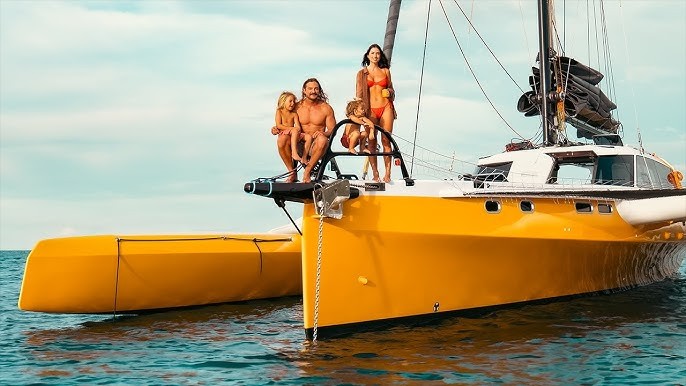
At Aeroyacht, we believe that mastering a multihull is a lifelong journey—one that blends instinct, experience, and respect for the sea. This article begins a new series on Multihull Know-How, where I’ll share practical seamanship insights drawn from decades offshore. In the coming editions, we’ll explore multihull handling, sail trim, heavy weather tactics, docking, anchoring, and the subtle skills that you may find helpful.
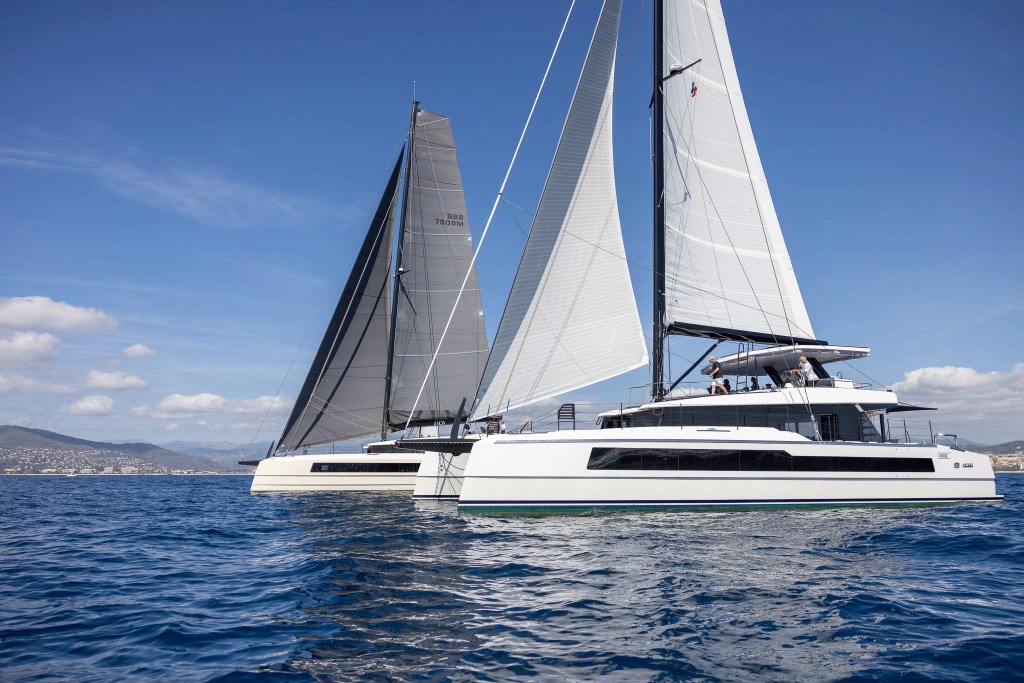
Sailing is an art. There is no absolute right or wrong way to perform a maneuver—only methods refined by experience and judgment. Perhaps the ancient Polynesian seafarers understood this better than anyone. Long before modern composites, electronics, or hydraulic winches, they navigated vast stretches of the Pacific in oceangoing multihulls. Their knowledge was passed down through generations, guarded almost as sacred treasure.
The successful colonization of distant Pacific islands was no accident. These mariners relied solely on their understanding of wind, sea, stars, and—above all—their ability to handle their vessels in any weather. They had no technology to fall back on. Only seamanship.
Sailing a Multihull
And that remains true today. However well-designed, engineered, and equipped your catamaran may be, her ultimate safety depends on experience, understanding, and good seamanship.
I firmly believe that every sailor should be capable of singlehanding a multihull—unless the yacht is specifically designed and operated as fully crewed. This cannot be overstated. Most cruising catamarans are sailed by couples, occasionally joined by guests who are often novices. If one partner becomes incapacitated, the other must be able to safely navigate and return to harbor. If sailing is an art, then singlehanding is its highest expression.
Having logged nearly 80,000 offshore miles on monohulls and multihulls alike, I consider myself fortunate to have shared ocean passages with remarkable people—some of whom became lifelong friends. Spend a week at sea with someone and you will know them better than if you had spent a year together on land. Weathering storms and crossing oceans forges bonds unknown to those who remain ashore.
Most of my Atlantic crossings aboard various catamarans were blessed with moderate conditions and the occasional calm. But one winter mid-Atlantic crossing stands out vividly: three relentless days in a Force 10 storm. We prevailed not because of the boat alone, but because of teamwork—and because we applied the art of seamanship.
Sailhandling: Monohull vs. Multihull
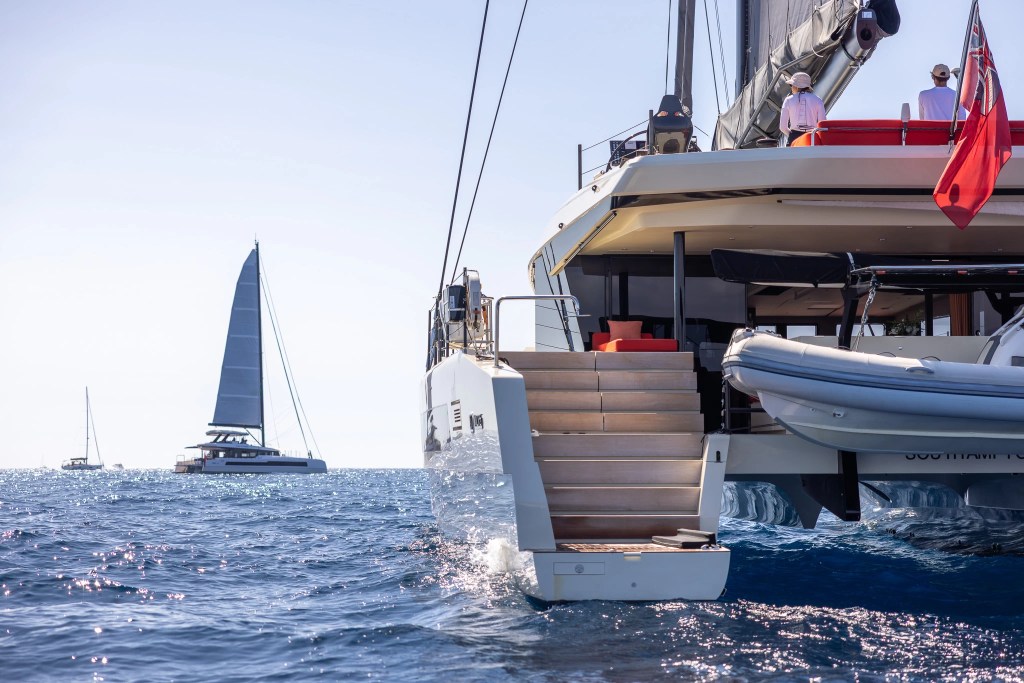
At its core, sail trim on a catamaran follows the same aerodynamic principles as on a monohull. Yet the experience differs in subtle—and important—ways. Your approach will depend on your background, the specific design you are sailing, and your personal philosophy of what sailing should feel like.
New sailors often adapt quickly to multihulls. Without ingrained monohull habits, they find catamarans intuitive and forgiving. For them, learning to sail and learning to sail a multihull happen simultaneously.
Experienced monohull sailors bring strong fundamentals—but must resist the temptation to constantly compare. Multihulls are not ballasted keelboats, and once that mental shift occurs, the transition becomes natural.
It is remarkable how much catamarans differ from one another—often more than monohulls do. A heavy cruising cat offers a very different experience from a lightweight, performance-oriented design. Yet despite decades of progress and market acceptance, multihulls are still frequently grouped together as if they were all the same.
Your personal philosophy also plays a role. Some sailors feel they are not truly sailing unless the boat is heeled over, spray flying, and crew bracing at sharp angles. If that is your benchmark, multihull sailing may surprise you. I have always appreciated the comfort, protection, and passage speed that a well-designed cruising catamaran provides.
Psychological Adjustments
For monohull sailors, shallow draft is often the first mental hurdle. Most cruising multihulls have fixed keels drawing between 2 and 4 feet, or daggerboards ranging from under 24 inches (boards up) to over 8 feet (boards down). Sailing quickly in five or six feet of crystal-clear Bahamian water can feel unnerving—at first.
Unlike monohulls, catamarans rely on form stability rather than ballast. Their safety and comfort depend on staying atop the waves, not plowing through them. Performance is closely tied to maintaining the designer’s recommended payload. Unfortunately, many liveaboard and charter cats are overloaded, which diminishes performance considerably.
Handling a light-displacement multihull requires finesse. Cats accelerate rapidly—and lose speed just as quickly when headed into the wind. This can challenge newcomers when anchoring, docking, or tacking. You must maintain momentum and often head slightly higher toward your intended stopping point than you would in a ballasted boat. It feels counterintuitive at first—but becomes second nature with practice.
Speed and Motion
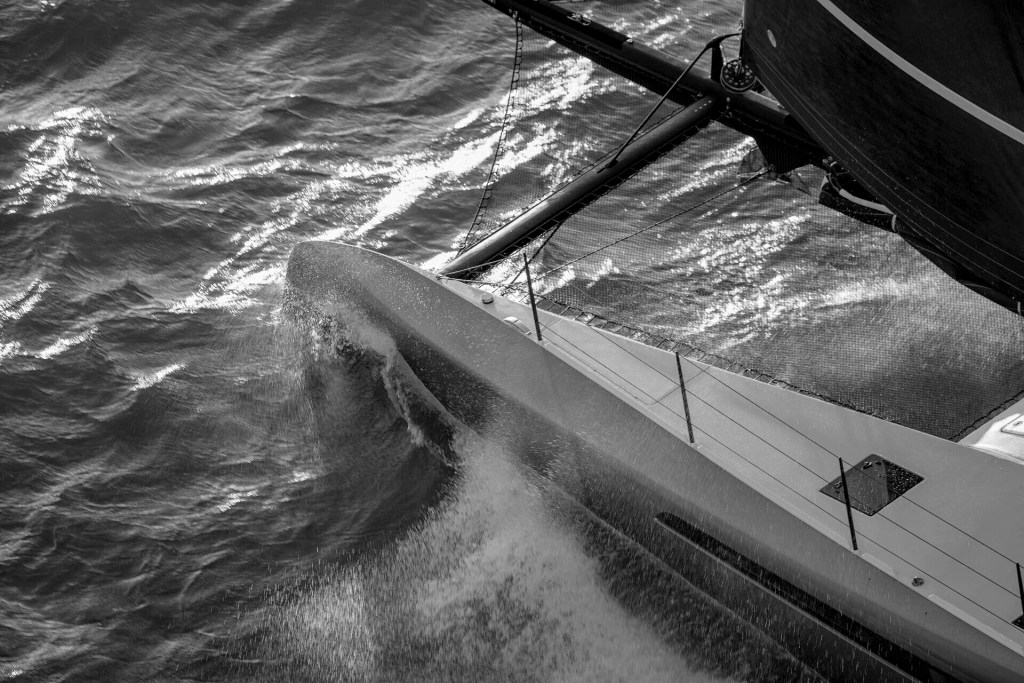
Although multihulls sail faster, the sensation of speed can feel muted. With little heel and a higher seating position above the water, the drama seems reduced—even as the numbers climb. Cats do not labor through waves like heavy displacement boats; they skim the surface. Motion is lighter, quicker, and less sustained.
The absence of heel is immediately noticeable. No bracing yourself. No sliding cookware. Less fatigue. Greater comfort—and ultimately safer operation.
Yet level sailing comes with less tactile feedback. On a monohull, increasing heel signals when to reduce sail. On a catamaran, you must read boat speed and sea state instead. Multihulls cannot spill gusts by heeling; they convert excess wind energy into acceleration. This takes adjustment—particularly on high-performance designs.
I thought I understood acceleration until I sailed a Formula 40 on Long Island Sound with Olympic sailor Keith Notary. The boat leapt from 12 to 22 knots in seconds—perfectly normal for that genre of catamaran.
Cruising cats maintain higher average speeds than comparable monohulls. Slower cruising designs match monohull passage speeds but offer higher peaks. Performance cruising cats can surf comfortably at 20 knots or more.
At higher speeds, apparent wind shifts dramatically forward. A monohull’s broad reach may become a close reach on a fast cat; a beam reach can resemble close-hauled sailing. Expect flatter sails and tighter sheeting angles for a given true windspeed. Everything happens faster—and requires earlier anticipation.
Deck Layout and Helm
Catamarans offer expansive deck space for sailhandling. Wide travelers, open foredecks, and bridgedeck saloons nearly level with the cockpit enhance visibility and communication. It is not uncommon for a crew member to assist with navigation while tending to life below—without losing situational awareness.
Because heel feedback is minimal, steering a perfectly straight course can initially feel challenging, especially sighting over a wide foredeck. Sail by the jib telltales or line up a fixed reference point. On passage, however, you may find you touch the helm surprisingly little—modern autopilots manage the majority of steering.
The Multihull Mindset
It may seem contradictory to say that catamarans are easier to sail—yet demand greater awareness. They offer shelter, level sailing, and often simplified sailhandling. But because they are faster, wider, and more stable, situations develop more quickly.
Navigation decisions must be made earlier. Reactions must be quicker. Anticipation becomes critical.
Modern catamarans have evolved dramatically over the past 50 years. Advances in engineering, materials, and design have created exceptional vessels. While their handling is grounded in timeless principles, there is always room to refine technique and elevate one’s seamanship.
In the upcoming articles in this Aeroyacht Catamaran Know-How Series, we will explore these techniques in greater detail—practical, experience-based insights designed to help you handle your multihull with confidence, safety, and mastery.
The above article is an excerpt from my reference book on multihulls, Catamarans: The Complete Guide for Cruising Sailors, available on Amazon in print and Kindle editions.