By Gregor Tarjan, founder of Aeroyacht.com
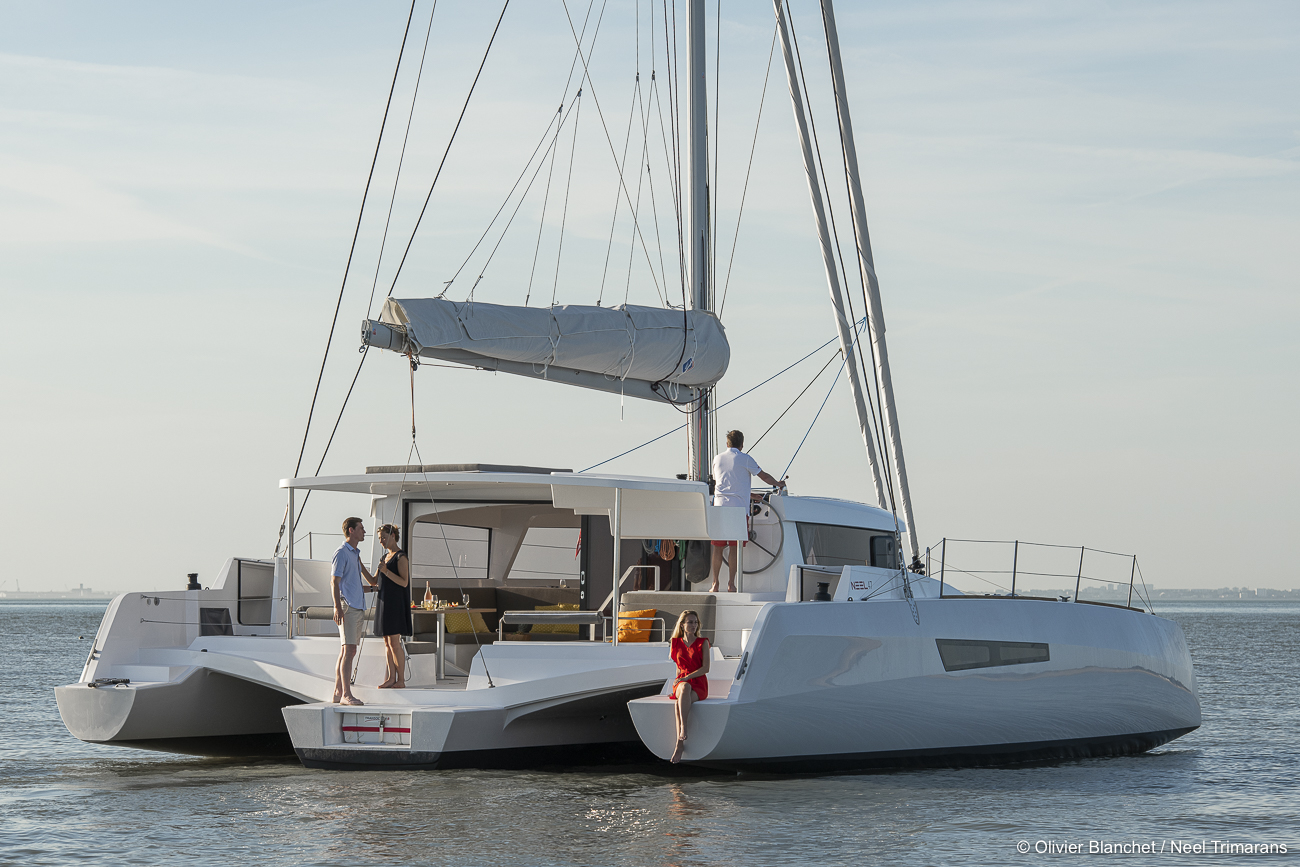
Over my 30 years in the multihull world, I’ve flown just about every sail type imaginable—on everything from monohulls, racing cats to luxury cruising multihulls. But occasionally, a piece of gear surprises even me. That’s exactly what happened when I installed a Furling Flat Reacher (FFR) from OneSails on my own NEEL 47 trimaran.
If you’re looking to simplify your sail inventory, extend your light-air performance, and reduce crew workload the FFR might be the most versatile headsail you’ve never heard of.
What is an FFR?
The Furling Flat Reacher (FFR) is a specialized, furling headsail developed by sailmakers like OneSails, designed to bridge the gap between a Code 0 and a gennaker.
It’s flatter and more upwind-capable than a gennaker, but it has more area and reaching power than a Code 0. Think of it as the “Swiss Army Knife” sail: not too flat, not too full—just right for a wide range of apparent wind angles.
The Real-World Test: My NEEL 47
On my personal NEEL 47 trimaran, I wanted a headsail that could give me good performance between 55 and 120 degrees apparent wind, without having to constantly switch sails. On a fast multihull such as the NEEL 47 trimaran the wind accelerates through the boat’s speed and you find yourself operating at closer wind angles than expected. Performance multihulls created their own apparent wind and move the wind angles forward – hence, you want a flatter sail. So I wanted something:
- Furling and easy to deploy
- Safe to handle solo or with limited crew
- Capable of giving me extra horsepower in light air
- Flat enough not to collapse upwind, but full enough to power up when deep reaching
That’s exactly what Peter Bresnan, head of OneSails in Mallorca delivered.
We flew my FFR on a continuous-line furler mounted to the bow, with a soft luff and no torsion cable—thanks to OneSails’ IFS (Integrated Furling Structure), the sail furls on itself like magic. Setup takes less than 2 minutes. No tangles. No drama.

Why It Works So Well on a Trimaran
Multihulls, especially trimarans like my NEEL 47 trimaran, love apparent wind. They accelerate quickly, which shifts the wind forward, keeping you in that sweet spot for a longer stretch of time. But this also means traditional downwind sails like asymmetric spinnakers can collapse or flog at tighter angles.
The FFR acts like a Code-0, with its flatter profile, handles this beautifully.
In light air (8–12 knots), We’ve easily made 7–9 knots of boat speed on a tight reach. Upwind of 60° AWA, the sail remains stable and efficient. At 90°, it’s in its element—pulling like a freight train but without the instability of a full gennaker.
Thanks to the wide base of my trimaran the sheeting base for the FFR is close to perfect. Even at deeper wind angles of 120-160 degrees the sail is not blanketed by the mainsail or self tacking jib and draws perfectly without collapsing.
The apparent wind accelerates through the slot created by the self tacking jib and a wind tunnel, suction-like effect gives extra wind power to the sail. Perfect.
Deep downwind, I’ll still switch to my larger (but more cumbersome) asymmetric spinnaker for deep VMG sailing, but for 80% of real-world cruising conditions, the FFR lives on the furler, ready to deploy in seconds.
Handling & Safety
The beauty of the FFR is not just in how it performs, but how it simplifies life aboard.
My friend Peter didn’t overpromise when he said that I will love this sail. Here’s what I like the most:
- Furl-and-go simplicity: No snuffers, no tangles, no drama. Pull the continuous, and the sail rolls up neatly. Reverse it, and you’re sailing. In addition to the Velcro lock on the leech, the furler even has a built in lock to prevent it from accidentally opening.
- Singlehander-friendly: I’ve deployed and doused the FFR alone in 20 knots apparent without leaving the cockpit.
- Compact stowage: When furled, it lives on the bow—no need to stuff it into a locker or bag between uses. Often we just drop it directly into the fwd stbd bow locker.
- Zero maintenance stress: With no torsion cable or extra gear, it’s clean and efficient.
- It furls tighter and neater than any other sail with a built-in torsion cable. The reduced diameter makes it more aerodynamic and creates less drag when leaving it hoisted. When putting it away, the smaller package stows easier as well.
This is the kind of cruising tool that makes you want to sail more often, and leave the engine turned off.
OneSails IFS Technology – A Game Changer
I opted for the OneSails FFR because of their IFS (Integrated Furling Structure) technology. Unlike traditional furling sails that require a heavy torsion rope, IFS integrates the structural elements into the sailcloth itself.
What that means practically:
- Less weight aloft
- Cleaner furling
- Improved sail shape
- Simpler rigging
For a boat like the NEEL 47 trimaran, which already prioritizes performance and weight balance, this is a big win.
How It Fits Into Your Sail Inventory
If you’re like many of my Aeroyacht clients, you’re looking to streamline your multihull’s sail plan. Most modern cruising multis now carry:
- A mainsail
- A self-tacking jib
- A Code-0 and/or Reacher
- A gennaker or spinnaker
I’d argue that, for many owners, the FFR could replace both the traditional Code 0 and the Gennaker, depending on your sailing goals. It doesn’t do everything, but it does most things well enough that it becomes your go-to headsail.
Especially for couples, families, and part-time sailors, reducing the number of sails (the weight, maintenance and the complexity of using them) keeps the sailing fun, not stressful.
Who Should Consider an FFR?
- Any cruising catamaran or trimaran owners
- Performance-oriented sailors who still want comfort and ease
- Short-handed crews and liveaboards
If you’re sailing between 55° and 140° apparent most of the time, this is your new secret weapon.
Final Thoughts
Every now and then, a piece of gear comes along that genuinely enhances the sailing experience. For me, on my NEEL 47 trimaran, the Furling Flat Reacher has been exactly that. It’s efficient, versatile, and incredibly easy to use—just the kind of sail that makes you fall in love with sailing all over again.
As always, if you’re curious whether the FFR is right for your catamaran or trimaran, feel free to reach out. At Aeroyacht, we’re not just selling boats—we’re helping you get the most out of the ones you already have.
Fair winds,
Gregor Tarjan
Founder, Aeroyacht.com
Author of “Catamarans: The Complete Guide for Cruising Sailors” (McGraw Hill, NY) and “Catamarans, Tomorrow’s Superyachts” (Sheridan House, NY)